Climate Change Impacts To Our Food System
- May 15
- 5 min read
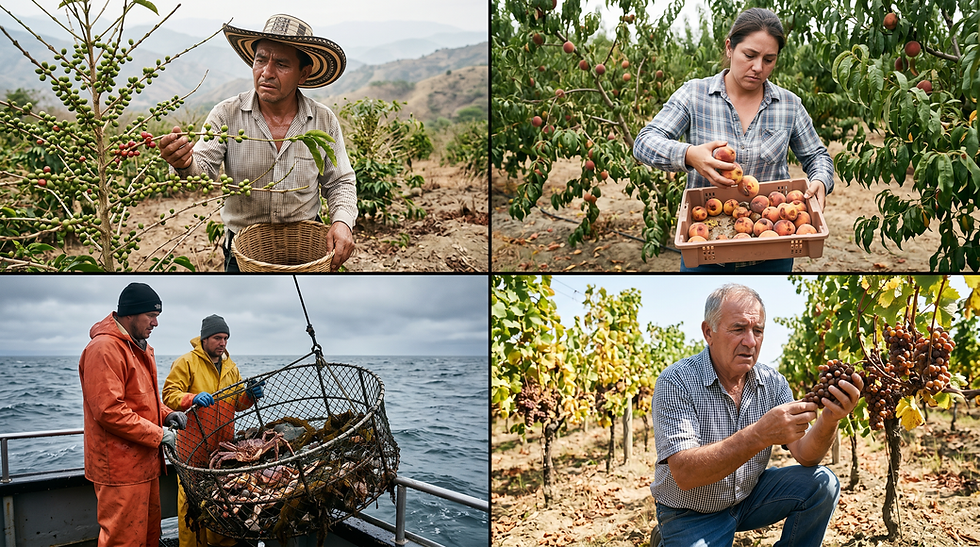
As I was digging into climate change and learning about the impacts to our ecosystems, I kept thinking that the effects of greenhouse gases and a warming planet will impact our food. I was right. As I was listening to a climate podcast, I heard Sam Kass speaking about this exact issue so I bought his book right away.
In the book, The Last Supper by Sam Kass he provides the following information about the climate change impacts to our food system:
Cacao, from which chocolate is made is at risk due to warmer temperatures on the planet. Cacao is produced by smallholder farmers in South America and Africa due to the specific temperature needed. These farmers frequently live below the poverty line. Chocolate companies have already started adding more preservatives and additives due to the cacao shortage.
This is the same for coffee beans. Farmers need cool temperatures at the base of mountains to grow coffee. Hotter weather is forcing growers to seek cooler temperatures higher on mountainsides. Kass says, "Scientists at England’s Kew Gardens speculate that by the end of this century 85 percent of the areas where wild coffee has traditionally grown will no longer support it".
Georgia peaches are also in trouble. In 2023 more than 90% of their crop was lost due to a heat wave and then early frost.
Salmon populations in the pacific northwest have declined by up to 90% in some areas due to warmer ocean temperatures and toxic runoff.
As for crab, fisheries in Washington and Alaska have faced an estimated $287.7 million in direct economic losses due to the cancellation of Bering Sea crab harvests between 2021 and 2023.
Corn farmers are also seeing impacts. Kass says, "In southern areas of the corn belt, yields are already dropping. With higher temperatures, even irrigation will not save corn." He goes on to say, "Even in rainier areas, he expects corn yields to drop by 25 percent by 2050 as floods alternate with droughts to plunge even more farmers into financial ruin."
Wine companies are at risk due to climate change, specifically droughts, temperature swings, and excess rain. To produce wine, grapevines need consistent weather. Ruinart is one of the oldest and most prestigious champagne producers in France and has been making champagne since 1729. In 2023 for the first time they had to use different grapes. Champagne vineyard owners are actually buying land in Great Britain to make wine.
Kass says that the above points are just a few examples but all farmers are getting hit by climate change. He says the following, "Warm spells during the spring in Wisconsin have caused the state’s apple crop to bloom too early, only to have blossoms destroyed by frosts. Blueberries in Maine and sour cherries in Michigan have suffered similar fates. Mild winters in New York state have provided ideal conditions for the fruit flies that feed on organic raspberries."
Yikes! We would think this would be on the news everyday. So what is causing all these climate change issues? Essentially, we've created too much carbon in the air due to fossil fuels and deforestation. For sea life, the ocean has become warmer and the acidification of the ocean has increased. Ocean acidification occurs due to atmospheric carbon emissions and when that carbon is absorbed by seawater, it's converted into carbonic acid. For example this increased acid is causing snow crabs to die off or grow smaller. This is also affecting California and Maine lobsters and shrimp. All of this is already happening to farmers and is just the beginning.
Modern farming is actually contributing to one-third of the greenhouse gases that are warming the world. This is because most farming doesn't use regenerative farming techniques. Regenerative farming actually takes carbon dioxide out of the atmosphere which is what we want. It does this by focusing on the holistic health of the soil and the ecosystem. In the book, What If We Get It Right? by Ayana Elizabeth Johnson, there's a quote that's really helpful in explaining regenerative farming, "To restore our agricultural soils, we need to re-embrace use of regenerative organic practices. That includes keeping roots in the ground, reduce tilling, and planting cover crops and perennials. We need to grow a greater diversity of crops, rotate those crops, use compost to replenish the nutrients in the soil, and eliminate chemical pesticides and fertilizers. Re-embracing these practices of regenerative agriculture will nurture healthy soil, which makes for healthy plants that collect atmospheric CO2 through photosynthesis". The book also makes an interesting point that farmers need to be certified to be considered "organic" but you don't need a certification to destroy the environment, exploit workers, and poison biodiversity with pesticides.
Another important point that I found all climate scientists saying is that humanity needs to cut down on our beef consumption. Cattle ranching generates two-thirds of agriculture's contribution to greenhouse gas emissions due to the deforestation required for the land, emissions from fertilizers used to grow the feed for the cows, and methane gas created by the cows. In Kate Marvel's book, Human Nature, she says the following, "The world’s insatiable demand for meat, especially beef, is fueling deforestation and grassland destruction; a switch to more plant-based diets would help slow or even repair the damage. Even eating less red meat and dairy, as opposed to none at all, will still go a long way toward reducing agricultural emissions."
What does this mean and what can we do? Based on my research, it doesn't seem like current-day politicians are creating policies for the betterment of humanity. Even though scientists are sharing this data, politicians seem more focused on war and the economy. I also don't think anyone is coming to save humanity, we need to save ourselves.
Below are the key points humanity needs to think about:
Electing political officials that are in service to humanity and the planet.
Speaking out about clean renewable energy and phasing off fossil fuels as soon as possible.
Expecting corporations to adopt mission statements focused on helping humanity and the planet.
Requiring everyone to have access to healthy organic food, especially children.
Investing in new inventions and technology that are focused on regenerative farming and new farming techniques like vertical farming.
Requesting policies that support regenerative organic farming
Speaking out against the use of pesticides.
I'm going to end this blog post by saying that humans are fighters and resilient. We are very powerful when we come together in groups and communities. Every soul cloaked in a human body is on this planet for a specific reason at this time. We are at a point of transformation, evolution, and change in the coming years. The best thing we can do is think positively about what we want for humankind and our planet and discuss these important topics among each other.



Comments