


The Air Quality Outside My Door is Hazardous and it Smells like Burning Plastic
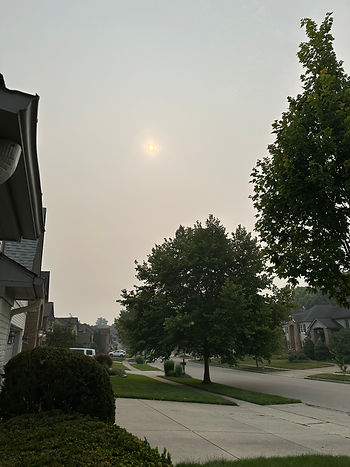
I live in Columbus, Ohio, and today I woke up to hazardous air quality from the Canadian wildfires. The air outside carried the unmistakable smell of burning plastic. Since it wasn't safe for children to spend time outdoors, I took my kids to see a movie. When we walked out of the theater, I looked across the parking lot at the smoke-filled sky, where the haze had nearly swallowed the sun. The eerie orange glow and thick blanket of smoke made it feel as though we had stepped into an apocalyptic movie.
It says the following in the Columbus news, "The AQI (Air Quality Index) on Friday morning reached 554 at 6 a.m. at Finland Elementary School on the city’s southwest side, beating the previous record of 208 observed at a sensor in Columbus on Oct. 14, 1999" (reference here).
I researched online today and scientific articles clearly state that worsening air quality is a known issue across our country:
"Wildfires have worsened ozone levels across the United States so much over the last decade that they have reversed around four years of progress, a new study has found. Surface ozone levels, or smog concentrations, steadily increased from 2015 to 2024, deteriorating air quality across the Midwest and Western U.S., researchers at the University of Iowa found in a study released Thursday. According to the study authors, this contributed to an increase of 318 premature deaths per year from fire-sourced ozone since 2013. Their NASA-funded research mapped these ozone levels in kilometer-by-kilometer grids across the entire continental U.S between 2003 and 2024 (reference here)".
Our planet has been warming for decades due to the burning of fossil fuels and deforestation. Scientists do realize that the climate naturally changes over time; however, scientists say that the Earth's climate is not supposed to rise consistently for more than a century.
As climate scientist Kate Marvel writes in her book Human Nature, "Hot and dry conditions make wildfires." Rising temperatures dry out soils and vegetation, increasing the risk that fires will ignite and spread rapidly. Warmer winters also leave trees more vulnerable to pests and disease, resulting in large amounts of dead wood that serve as fuel for wildfires. In addition, a warmer atmosphere can contribute to conditions that increase lightning activity, creating more opportunities for fires to start. Together, these factors create ideal conditions for larger, more frequent wildfires across our planet.
Climate scientists have provided solutions to our climate change issues and they've been screaming from the rooftops hoping people will listen. Key solutions are below:
Invest in renewable energy like wind and solar and transition away from fossil fuels (coal, oil, and gas) as fast as possible.
Transition over to regenerative agriculture which is about soil health and actually draws CO₂ out of the air and into the ground. Regenerative agriculture refers to no tilling, no pesticides, and using cover crops.
Reforestation because trees cool the planet and also pull CO₂ out of the air through photosynthesis.
Humanity needs to transition over to a more plant-rich diet. This is because "raising livestock accounts for nearly 15 percent of global greenhouse gases emitted each year (Drawdown, p38)".
For anyone interested, I would suggest Paul Hawken's book, Drawdown where seventy individuals from twenty-two countries gathered a comprehensive list of climate solutions that provide the greatest potential to reduce emissions or sequester carbon from the atmosphere. His book is a great resource for understanding the solutions we already have.
In the car on the way home from the movie theater today, my children asked me why there were forest fires and smoke in the air. I told them that humanity needs to stop burning fossil fuels like oil and gas and we need to focus on renewable energy like wind farms and solar panels. I also told them that we need to stop cutting down our forests and instead grow trees. They seemed to understand. They asked me what will happen if we do nothing and I decided to be honest. I told them that we will struggle to grow food and experience food shortages.
I also told them that humanity will make the needed changes before it's too late so that I left them with hope. I believe what I said because I see humanity gradually awakening. As more people become aware, we begin to recognize the impact our actions have on both the planet and ourselves. I know this transformation is possible because I experienced it personally. I emerged from what felt like a deep slumber with a profound sense of responsibility for the Earth and for the future of humanity.
This Great Awakening stage we are in is an important phase as the human race evolves and ascends into higher levels of consciousness. I believe this awakening stage includes several key realizations:
Recognizing that reality extends beyond the physical world. We begin to understand that there is an energetic dimension to existence, which quantum physics and future scientific discoveries will support more fully.
Becoming aware of corruption and greed within society. As our awareness grows, many people begin questioning systems that prioritize power and profit over human well-being, inspiring a desire to create institutions that help all people thrive rather than merely survive.
Seeing ourselves as part of a much greater universe. We begin to consider that consciousness and the soul may extend beyond Earth, with opportunities for learning, growth, and evolution that reach far beyond our own planet.
Realizing our interconnectedness with all life. We come to see that humanity, the Earth, and all living beings are woven together in a web of life. This is called Oneness.
As humanity continues through this awakening process, I believe we will increasingly strive for a world with clean air and thriving ecosystems. Someday, we may look back on these days—when thick smoke dimmed the sun and we walked out of the movie theater into hazardous air—and wonder how we ever allowed things to drift so far off course. More importantly, I hope we will look back with gratitude, knowing we found the wisdom and the will to change our ways before it was too late.


Comments